


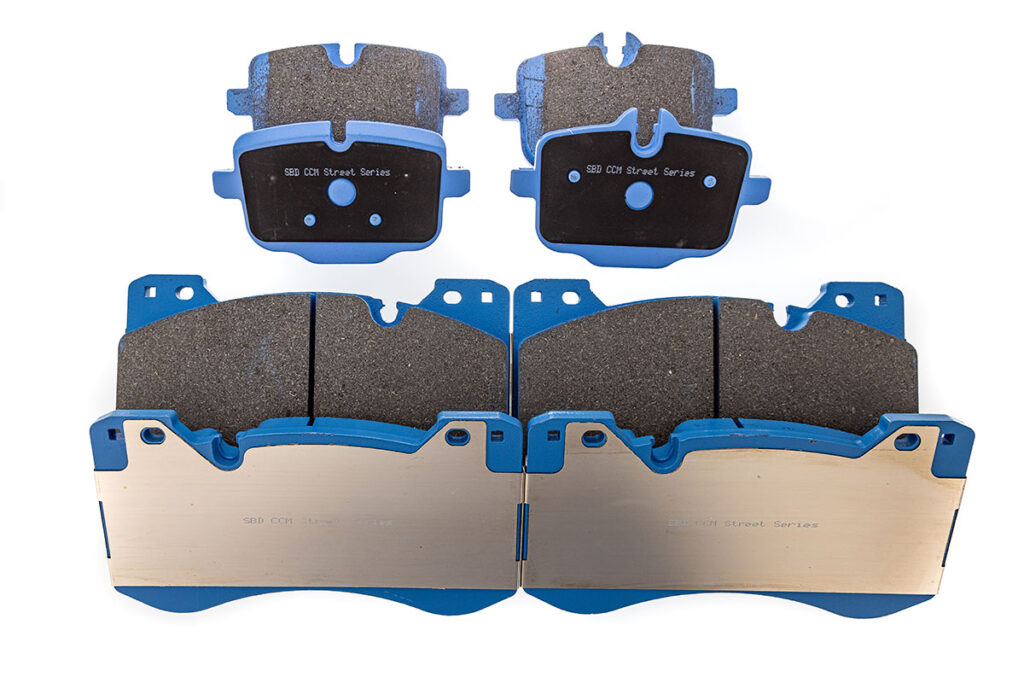
- Fits OE BMW Calipers for Iron Rotor to CCM Upgrade Conversion (Standard Caliper for BMW M2, M3 & M4)
Our Carbon-ceramic Street Series brake pads represent the forefront of high-performance braking technology. Our advantages stem from the precise integration of carbon-based structures with ceramic fibers, combined with advanced polymer binders. This composite formulation delivers an average friction coefficient of 0.45–0.48, superior fade resistance, and stable operation under temperatures exceeding 800°C.
The secret is in our friction ingredients. All materials are sourced from leading global suppliers, ensuring consistent quality that meets the stringent demands of both motorsport and premium road applications.
⸻
Material Composition & Technical Features
-
DuPont Kevlar® Fiber
• Provides exceptional tensile strength and impact resistance, significantly enhancing pad toughness.
• Balances rigidity and elasticity, ensuring consistent friction performance during prolonged use.
-
Otsuka Chemical (Japan) – Potassium Titanate
• Maintains friction stability at high temperatures.
• Reduces noise and vibration (NVH) while optimizing pad-to-disc surface interaction.
-
Morgan Advanced Materials – Ceramic Fiber
• Ensures outstanding heat resistance and insulation, sustaining friction levels even beyond 600°C.
• Uniformly disperses heat to prevent localized hot spots and thermal cracking.
-
Sumitomo Chemical (Japan) – Phenolic Resin
• Serves as a high-performance binder with excellent adhesion and thermal durability.
• Preserves pad structure through repeated thermal cycles, extending product lifespan.
-
SGL Carbon (Germany) – High-Purity Graphite & Carbon
• Provides superior thermal conductivity, enabling rapid heat dissipation and reducing fade.
• Offers natural lubrication, lowering brake dust emissions and disc wear.
• Acts as a carbon matrix reinforcement, strengthening the composite structure.
-
Tokai Carbon (Japan) – Carbon Materials
• Supplies high-purity carbon powders and fibers, ensuring strength and stability at extreme braking temperatures.
• Widely used as a core material in carbon-ceramic brake system reinforcement.
⸻
Key Advantages
• Stable Friction Coefficient (0.45–0.48) – Provides predictable, linear braking response across all temperature ranges.
• Extreme Heat Resistance (800°C+) – Maintains braking performance under the most demanding motorsport and high-load road conditions.
• Outstanding Fade Resistance – Ceramic fibers, potassium titanate, and carbon reinforcements prevent high-temperature performance loss.
• Low Dust & Low Corrosion – Graphite and carbon materials minimize brake dust, reduce wheel contamination, and protect disc surfaces.
• Comfort & Quiet Operation – Advanced material balance reduces NVH, suitable for both road comfort and track performance.
• Extended Durability – Premium global materials ensure longer pad life and lower maintenance frequency.
• Stable Friction Coefficient (0.45–0.48) – Provides predictable, linear braking response across all temperature ranges.
• Extreme Heat Resistance (800°C+) – Maintains braking performance under the most demanding motorsport and high-load road conditions.
• Outstanding Fade Resistance – Ceramic fibers, potassium titanate, and carbon reinforcements prevent high-temperature performance loss.
• Low Dust & Low Corrosion – Graphite and carbon materials minimize brake dust, reduce wheel contamination, and protect disc surfaces.
• Comfort & Quiet Operation – Advanced material balance reduces NVH, suitable for both road comfort and track performance.
• Extended Durability – Premium global materials ensure longer pad life and lower maintenance frequency.